.
|
Learning
About Biomechanics
by
Kimberly Cruser,
Ventura Chapter, California Dressage Society
|
.
For
those of us on the continuing search for improvements to our riding skills,
the USDF University accredited lecture given by Mr. Stephen Apatow to members
of the Ventura and Pomona CDS chapters in Dec 2000, was a great opportunity
to learn more about the biomechanics of the human body and the muscle control
and tone needed to ride well. Mr. Apatow gave an in-depth background
on his own journey in other disciplines to find a base from which the human
body can ideally work from, regardless of the sport. Ballet became the
basis for his approach and understanding of how the human body should function.
During the seminar, he gave the participants exercises with which to discover
the current range of motion they had, and then ways to further develop towards
the ideal. This was then carried out in more detail during the
individual consultations that he gave.
The individual consultations began with his detailed examination
and manipulation of the areas of the body that were restricted, namely shoulders/thoracic
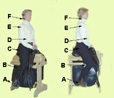
area, back, legs, and feet. After that he had each person climb onto
a “static barrel” (one of those wooden frames resembling a horse’s back that
you try on saddles at a tack store on) that had a saddle on it, and took the
body through the stabilization and movements required in riding. It
sounds simple, but was quite complex and often painful! Different people
had different reactions to his requests for movements like the posting trot
and turning aids, showing how easily it is to translate instructions incorrectly
when following directions. The turning portion caused consternation
in a number of participants, who wondered if they then needed to go home and
retrain their horses! Mr. Apatow responded, that was not what he was
trying to impart, instead he was trying to show the level of isometric control
needed, and the evenness throughout the human body that was required in
order to have that utter stillness that so epitomizes the top riders of the
world. No one had the abdominal strength that he recommended as necessary
to that stillness and control and very few had sufficient suppleness throughout
the shoulder/neck regions.
The two most valuable contributions that Mr. Apatow brought were
the importance of the abdominal muscles and the correct placement and suppleness
of the shoulders/thoracic area. These two areas, followed by the correct
alignment of the hip and knee over the foot, are almost completely ignored
by the majority of educational material that is currently available.
When they are mentioned, it is only in passing, not the detailed examination
that is needed, and was provided by Mr. Apatow. Everyone came
away with an awakened understanding of their own bodies, and hopefully a glimmer
of what they needed to do to improve biomechanically on and off the horse.
He noted that riders cannot expect to be biomechanically correct for the
hour or so that they are on their horse, it is something they must try to
attain and maintain every minute. From his own journey, aiming at Olympic
competition, he pointed out that for each rider and horse pair, an examination
of the weaknesses of both must be carried out in detail. This is then
followed by the creation of a plan of exercises or therapy to help each repair
or minimize those weaknesses while fostering existing strengths. It
is not enough to just get on and ride each day hoping to get more proficient
just by trying harder, longer. Practice does not make perfect, only
perfect practice does. Learning the biomechanics involved for both
the horse and the rider makes the practice closer to perfect…
But how do you make a horse practice perfectly? Mr. Apatow
gave a 5 year old, first level horse, Smoke, an “individual” consultation,
just as he did for some of the lecture participants. He began by examining
Smoke, first one side and then the other, looking for tight spots in the tissues,
muscles, and ligaments and working to soften them. He found problems
in Smoke’s left jaw and a variety of tight areas in his neck and shoulders.
His hips and lower back were also problem areas. Smoke resented being
poked and prodded but allowed the ministrations, and even responded with
some licking and chewing actions which are supposed to show “releases” in
the tissues (per other modalities anyway). Mr. Apatow warned
that he would be quite sore for the next day or so and not to expect too
much immediately. Smoke has frequent Bioscan sessions and has
his own chiropractor/acupuncturist, both are done once a month…and they had
pinpointed these same problem areas but hadn’t managed to resolve them to
any significant degree. What Mr. Apatow clarified was the reasons behind
these problems. After questioning the owner on Smoke’s history, it
was discovered that the hip problems were due to running into gate posts
when he was younger and the shoulder problems most likely a result from
taking a bad fall in the arena while going too fast as a youngster.
Smoke had developed compensatory ways of moving to deal with those traumas
when he was younger, and had carried those bad habits with him long after
the injuries themselves had healed. Mr. Apatow said it would be up
to the owner to help Smoke learn to use his body evenly again, and to be
vigilant about not letting Smoke continue in those old patterns.
The next day the owner reported the right shoulder that had always
been more constricted than the left, was taking a longer stride and he no
longer looked as short-strided in front. Smoke also had a much more
relaxed expression on his face. Only time will tell if there is going
to be lasting improvements, but Mr. Apatow said that animals are much more
dramatic in their changes than humans are, and that once they are convinced
that it won’t hurt they’ll go back to using themselves correctly and give
up the old, habitually bad patterns. In other words, they’ll
practice more perfectly!
###
|